
 [photo: wikipedia]
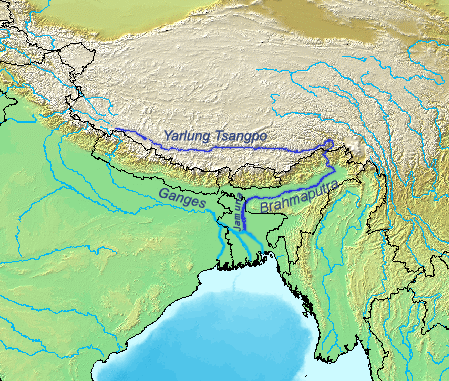
1. Brahmaputra (Yarlung Tsangpo), one of the last two free-flowing, undammed major rivers in Tibet, AND China, is also being dammed. Salween is the other major river that environmentalists tried to save from dam projects but to no avail. A China Daily story yesterday acknowledged that the "Zangmu Water Power Station" is on the main stream of the middle reaches of Brahmaputra, at dZam (རྫམ་) township. Sources tell me that there are five dams planned in this section of the river, and construction has been going on since 2006. This means there is no undammed major river in China and Tibet. The installed capacity of 'Zangmu Water Power Station' will be 510 MW (85 MW x 6 turbines). The project is located in Lhokha (Shannan) Prefecture of Tibet Autonomous Region, about 140 km southeast from Lhasa, between Zangs-Ri (Sangri) and rGya-Tsha (Jiacha) counties. Construction work on the first dam is likely to start soon. Huaneng, China's top power company, is backing the financing of the project and, Gezhouba, one of China's biggest dam construction companies, will build the project. This news should be particularly alarming for people living in downstream countries of India and Bangladesh. China is likely to approve more dam projects on the Brahmaputra this year.
2. In March 2007, Tibet Environment Bureau approved another five dams on the headwaters of Mekong (Zachu) in Chamdo Prefecture. China has already built several dams on the Mekong in Yunnan Province that have impacted downsteam ecology and livelihoods. The Mekong River flows into Thailand, Burma, Cambodia, Laos and Vietnam. This time, however, authorities have released the Environmental Impact Assessment report of the Zachu dams. As far as I know, this is the first time China has released EIA of dam projects on transboundary rivers.
The total installed capacity of the five dams will be 510 MW. The names of five dams are (all in Chinese): Dhongzhong, Guoduo, Xiangda, Ruxi and Linchang. These dams are located close to each other, around 31 degree North latitude and 97 degree East longitude. This is a low population rural area at an altitude about 4,335 meters (14,225 feet). Dhongzhong and Guoduo are located near Tsher-dBad (ཚེར་དབད་ / Cerwai' in Pinyin) township, Xiangda is located near Re-Thong (རེ་ཐོང་ / Retong in Pinyin) township. Ruxi and Linchang are located near Ru-bZhi (རུ་བཞི་ / Ruxi in Pinyin) township.


7 comments:
this is serious case for the world and India and Bangladesh particularly.
northern part of Indian states economy are depend on river of Brahmaputra. Construction of dam will be very serious issue for both country and will leave both states with shock like Pakistan.
Thanks for your comment Rinzin. Good wishes.
Construction on Guoduo dam near Chamdo has started on 28 November 2009. See report in Chinese here:
http://www.xizang.gov.cn/getCommonContent.do?contentId=368600
Thanks James. Update noted.
Let’s sort out a few questions remaining on the Yarlung Tsampo gorge dams between Zangs-Ri (Sangri) and rGya-Tsha (Jiacha) counties.
Zangmu HPP
Construction on Zangmu Power station is well underway and it will start producing power in 2013. The electricity goes to Lhasa as a high voltage power line is planned for connecting the Lhasa power grid to Zangmu.
Technical details as published in June 2009 and probably the final version: Long term average flow rate of the Yarlung Tsampo at the site is 1010 cubic meters per second. The dam will be 116 m high and the normal water level maintained at 3310 m above sea level. The calculated base of the dams’ foundation is at 3198 m, the dam is 389.5 m long and 76 m wide at the bottom and 19 m at the top. The water level during operation should not fall below 3305m. This means the flow rate of the river further down streams will be maintained as it can only vary by 5 meters. During normal operations the reservoir will have 86.6 million cubic meters of water. This is the amount of water flowing on average about every 24 hours down the river. Installed power generating capacity is 510 MW and expected power generating capacity is 2.5 billion kw/h per year.
The building cost of the project is 7.91413 billion RMB (about 1.1 billion US dollars). Total cost including machinery, transmission lines and resettlement costs for locals is estimated as 9.56134 billion RMB (1.328 billion US dollars).
The impact on the local population is resulting in a resettlement plan for people in part of Jiacha and Sangri counties. The three villages of Zangmu, Tangmai and Dagu (all names in Pinyin) are mentioned. In Chinese the names are 加查县拉绥乡藏木村、安饶镇塘麦村,桑日县增期乡达古村.
The money as part of the budget reserved for relocation work and compensation of local inhabitants is 137.83 million RMB (19 million US dollars) or 0.2% of the total construction cost.
If you want to look how the dam looks when finished go to the Chinese language website of Jiacha county:
http://www.xizangjiacha.gov.cn/html/tscy/2008-7/7/12_56_25_196.html
Wait some time until the animation at the top of the page is downloaded and becomes visible. You see the model of the dam as it will look in the year 2013. The writing in Chinese appearing at the same time means: “Zangmu water power station, the first dam on the Yarlung Tsampo”.
Jiacha HPP
This power station is now in the final planning stage. In August 2009 as a result of a meeting held in Chengdu the following plan was agreed on:
The location of the power station is 5 kilometers to the west or upstream of Jiacha county seat. The installed power generating capacity is 320 MW and the dam will maintain a water level of 3244 m above sea level. The reservoir will be filled with 28.87 million cubic meters of water. The expected power generating capacity is 1.527 billion kw/h per year.
In general terms the power station will be about 60% of the size of the upriver Tangmai HPP. The two power stations are about 12 kilometers apart.
Other Power stations on the main stream of the Yarlong Tsampo are still in the early planning stage. It is important to remember that what is now built, the Zangmu HPP, took 3 years of preparation work.
"Who controls the resources will control the world", seems like dragons are following this adage very closely.
All this dam works are disguised as power projects but the real intention is to control the resources of NORTH-EAST region of India. This is just a beginning of a big plan to take control on dragon's region of interests.
Indian government as always is in deep sleep and still considers dragon as its friend. It is high time for India and the world to wash their eyes and start looking at dragons advancements through political prism.
Can anybody provide us the technical details of the the projects planned on the mainstream Yarlung Tsanpo, for example, those at Lengda,Zhongda, Langzhen, Jiexu, Jiacha and Zangmu? We also need information on geographical location and geo-coordinates to assess impact of these dams on downstream areas. The information already given by different people on this blog are appreciated.
Post a Comment